
Tenant Directory Board Cost Guide
Practical guidance from the team that surveys, makes and installs commercial signage. If you have a live project, we can help you choose the right route.
A directory board in a shared lobby has one job: get a visitor to the right floor or unit without needing to ask. The specification choice that matters most is how easily it can be updated later, since a multi-let building will see tenants come and go over its lifetime, and a board designed only for the day it was installed quickly becomes a maintenance headache. This guide covers the static versus modular decision and what typically affects cost. We work with managing agents on multi-tenant buildings across Hertfordshire, Bedfordshire, Buckinghamshire, Cambridgeshire and London to keep directory boards current as occupiers change.
We look forward to hearing from you
A printed static board is the cheapest option but means a full replacement every time a tenant changes.
Static versus modular directory boards
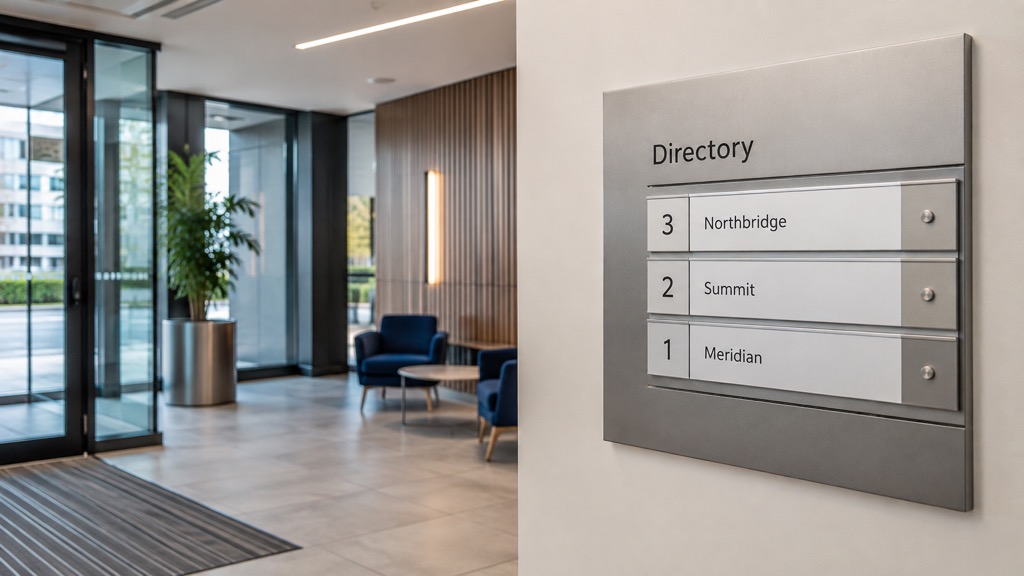
A printed static board is the cheapest option but means a full replacement every time a tenant changes. A modular board with individual sliding or magnetic name strips costs more upfront but avoids that ongoing replacement cost, which usually pays for itself within a handful of tenant changes on a multi-let building.
Ready when you are
Managing a directory board for a multi-tenant building? Use the form above to tell us about the site, or get a fixed estimate directly.
Get an EstimateCommon questions
For most multi-let buildings, a modular system pays for itself within two to three tenant changes compared with reprinting a static board each time.
Yes, backlighting is common in larger lobbies where the board needs to remain legible in lower ambient light.
Yes, this is common in larger buildings, often combined with the tenant list on the same or an adjacent panel.
This is usually the responsibility of the building's managing agent or landlord as part of common area upkeep.
They can, though many buildings use a combination, since a physical board needs no power and remains visible during any digital system downtime.